
Key takeaways
- Individual boards can often be replaced when the damage is limited and compatible material is available.
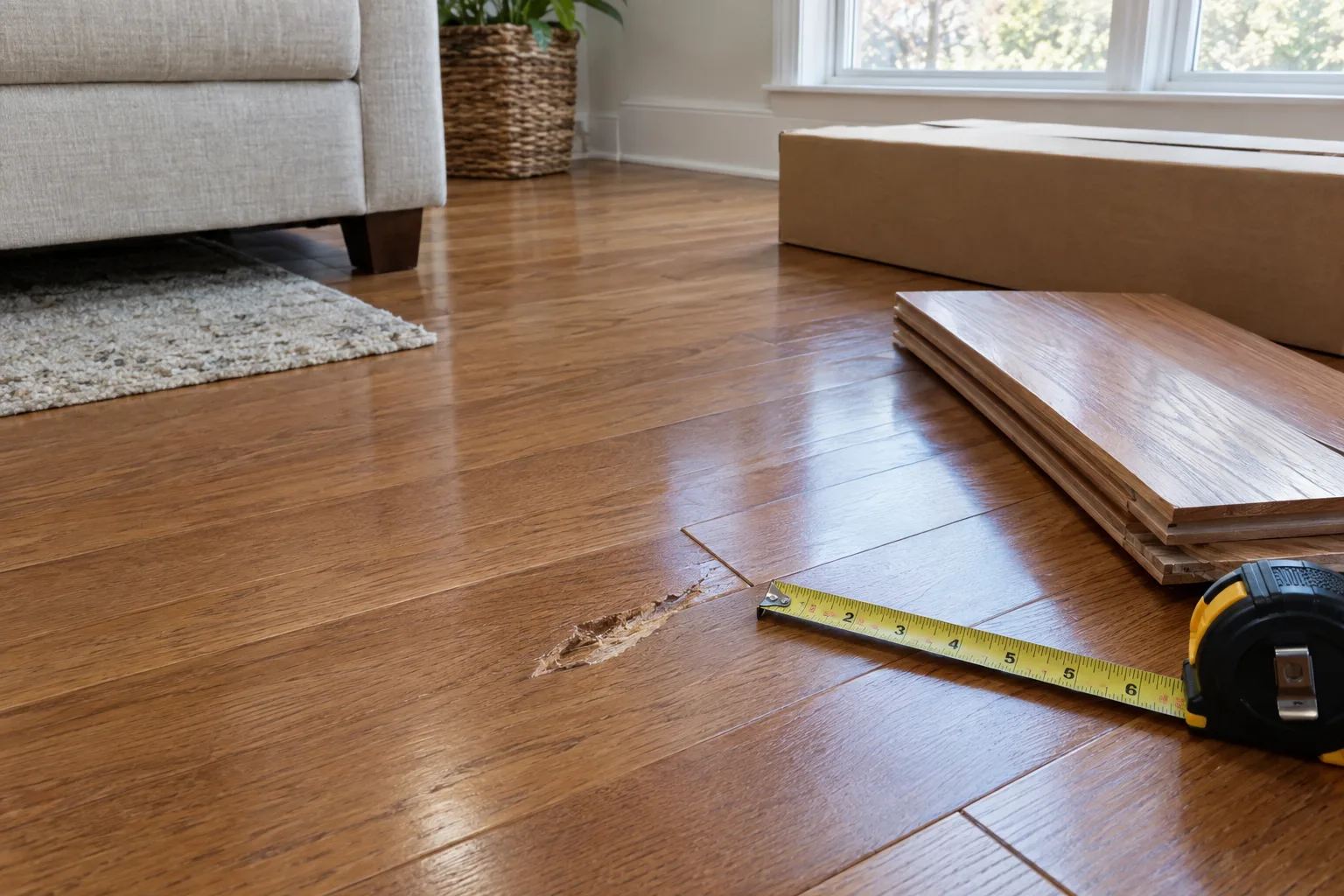
- Send close and wide photos, a board-width photo with a tape measure, spare-board labels, and the damage history.
- Floor construction, attachment, board dimensions, edge fit, and moisture conditions affect whether a repair is practical.
- A compatible replacement may still look different from the surrounding aged floor.
- Mike installs compatible replacement boards but does not sand, refinish, stain, or finish an unfinished floor.
Yes, you can often replace individual hardwood floor boards without replacing the whole floor. The replacement boards must fit the existing floor, and the cause of the damage needs attention before installation. You also need to be comfortable with how the replacement will look beside the surrounding boards.
For a homeowner near Taneytown, the useful first step is gathering information, not buying replacement wood. Send Mike photos and a short damage history to start a conversation about hardwood floor repair.
When can a few replacement boards be enough?
Individual-board replacement may make sense when damage is limited to a small area. Examples include a split board, a deep gouge from an impact, or a few boards damaged by a past leak that has been resolved.
The surrounding floor matters just as much as the visible damage. A small stain does not tell you whether the material below it is dry and sound. Several lifted boards may point to a problem that extends beyond those boards.
Use these observations to prepare for an assessment, not to diagnose the floor yourself:
| What you notice | What needs to be established |
|---|---|
| One deeply gouged board | Whether a compatible board can fit the existing floor |
| Several boards damaged after a leak | Whether the leak is resolved and moisture conditions are suitable |
| Boards lifting or changing shape | Whether moisture or movement affects a larger area |
| Damage in several rooms | Whether spot repairs are practical compared with broader replacement |
You do not need to decide which category your floor fits before contacting Mike. Clear photos and a short history are enough to begin the conversation.
What should you send Mike before an assessment?
Use this checklist for your first text:
- Take a close photo of the damage and a wider photo showing neighboring boards.
- Photograph a tape measure across the visible width of one board.
- Photograph spare-board packaging, labels, and product numbers, if available.
- Photograph an accessible board end only if it is already visible.
- Estimate how many boards appear damaged and say when you noticed the problem.
- Note any leak, spill, impact, or seasonal change that came before it.
- Say whether a basement, crawl space, slab, or another room sits below the area.
- Include your town and mention any dampness you have noticed below the floor.
Do not pry up a board or remove a threshold just to gather information. If you do not know the wood species, construction, or attachment method, say so. Guessing can lead to ordering the wrong material.
Photos help narrow the questions. They cannot confirm hidden conditions or replace an on-site assessment when one is needed.
Why does a similar color not mean a compatible board?
Two boards can look similar and still be incompatible. Width, thickness, length, and edge shape affect fit. Solid hardwood and engineered hardwood also differ in construction.
The National Wood Flooring Association installation guidelines call for checking species, grade, dimensions, edge profiles, sheen, color, and replacement-board moisture.
That means a product photo or color name is not enough. Even a board sold under a familiar product name needs its actual specifications checked. The edges must work with the existing floor, not just resemble it from above.
Appearance needs a separate conversation. Your existing floor may have changed color through age, daylight, and use. A compatible new board can still stand out. Do not plan on an invisible patch.
Mike does not sand, refinish, stain, or finish an unfinished floor. His repair work stays focused on installing compatible replacement boards. Unfinished replacement wood is not a complete solution Mike provides.
Do you need spare original boards?
Spare original boards are worth locating, but they still need assessment. Their dimensions, condition, and storage history matter. A matching label alone does not establish that a leftover box is ready to install.
If you have no spare boards, send any product information you can find before buying anything. Ask Mike whether a candidate replacement can be assessed for your repair. Availability and fit need confirmation before damaged boards are removed.
You can select hardwood at Baltimore Floor Works, 142 Railroad Ave. in Westminster, or at Lowe's or Home Depot. You can buy the selected material yourself, or Mike can order it, usually through Baltimore Floor Works. Mike does not bring samples to the house.
For an existing-floor repair, discuss compatibility before placing an order. A similar-looking product may not work with your floor.
What needs checking below the damaged area?
If water may be involved, replacing boards is only part of the decision. The source needs attention, and the affected materials need assessment before installation proceeds.
For your Taneytown-area home, report the conditions you actually see. Do not assume the cause based on the house's age. Useful details include a plumbing leak, damp basement walls after rain, a wet crawl space, or a musty smell below the damaged room.
The University of Minnesota Extension guide to basement moisture identifies rainwater, indoor moisture, and humid outdoor air condensing on cool surfaces as possible sources. Those are possibilities to investigate, not a diagnosis of your house.
Abnormal moisture conditions need to be identified and addressed before installation. The assessment should establish conditions in the flooring and accessible supporting material. A surface that feels dry does not establish that the whole assembly is ready.
An active plumbing leak, drainage issue, or other moisture source may need another trade before replacement boards can be installed. There is no single waiting period that answers this for every floor.
What should an on-site assessment establish?
The assessment needs to answer several practical questions:
- Is the floor solid or engineered hardwood?
- Is it nailed, stapled, glued, or floating?
- What are the actual board dimensions and edge profiles?
- Is the surrounding floor sound enough for a localized repair?
- What is the condition of the accessible subfloor or other supporting material?
- Are moisture conditions suitable for the selected product?
- Is compatible replacement material available?
These are assessment needs, not a description of one replacement method for every floor. The construction and attachment system affect what work is practical. Have Mike confirm whether your particular floor is a suitable repair job before buying material or planning removal.
Before a visit, clear rugs, small furniture, and loose belongings from the damaged area. Make spare boards and labels accessible. Identify any safe, ordinary access to the basement or crawl space below. Do not enter an unsafe space or move heavy items without help.
How can you plan the repair before committing?
First, establish whether the damage is local, whether its cause has been addressed, and whether suitable material exists. Then discuss the repair scope and appearance limitations.
Ask which boards are included, whether surrounding damage could change the scope, and what you need to clear before work begins. A small visible patch alone does not establish how much work is needed.
Current rates are on the pricing page. The estimate tool shows a preliminary range that is not a contract.
Mike serves homes about 50 miles from the Taneytown office. Include your town with your photos so the location can be confirmed along with the repair details.
Call or text Mike at (410) 259-7094 to discuss your hardwood floor repair. Leave a voicemail if nobody picks up.
Questions people ask
Can you replace individual hardwood floor boards?
Often, yes. The damage needs to be suitable for a localized repair, compatible replacement material must be available, and the cause of the damage needs attention before installation. A replacement board may still look different from the aged floor.
What photos and measurements should you send Mike?
Send close and wide photos, plus a photo with a tape measure across one board's visible width. Include spare-board labels, the damage history, your town, and what sits below the floor. Do not pry up boards to gather information.
Do you need spare original boards?
Spare original boards can help, but their dimensions, condition, and storage history still need assessment. If you have no spares, discuss compatibility with Mike before ordering replacement material.
Can Mike make replacement boards match by sanding or staining them?
No. Mike does not sand, refinish, stain, or finish an unfinished floor. His repair work focuses on installing compatible replacement boards, with appearance limitations discussed before the work.
What moisture problems need attention before replacement?
Active leaks and other abnormal moisture conditions need to be identified and addressed before installation. The assessment should establish what needs measuring and whether another trade must resolve the source.
Sources
- Angi: How to Replace Damaged Hardwood Floor Planks Without Removing the Entire Floor. Search-result competitor reviewed for coverage and gaps.
- Young Brothers: Can Individual Hardwood Floorboards Be Replaced? Search-result competitor reviewed for coverage and gaps.
- Top Floorings Depot: How to Replace or Patch Damaged Hardwood Boards. Search-result competitor reviewed for coverage and gaps.
- National Wood Flooring Association: Installation Guidelines. Primary technical source for compatibility, moisture assessment, and board replacement.
- Bruce: Hydropel Installation Instructions. Manufacturer guidance identifying professional board replacement as an option for major damage.
- University of Minnesota Extension: Moisture in Basements, Causes and Solutions. Primary extension guidance for investigating conditions below the floor.