
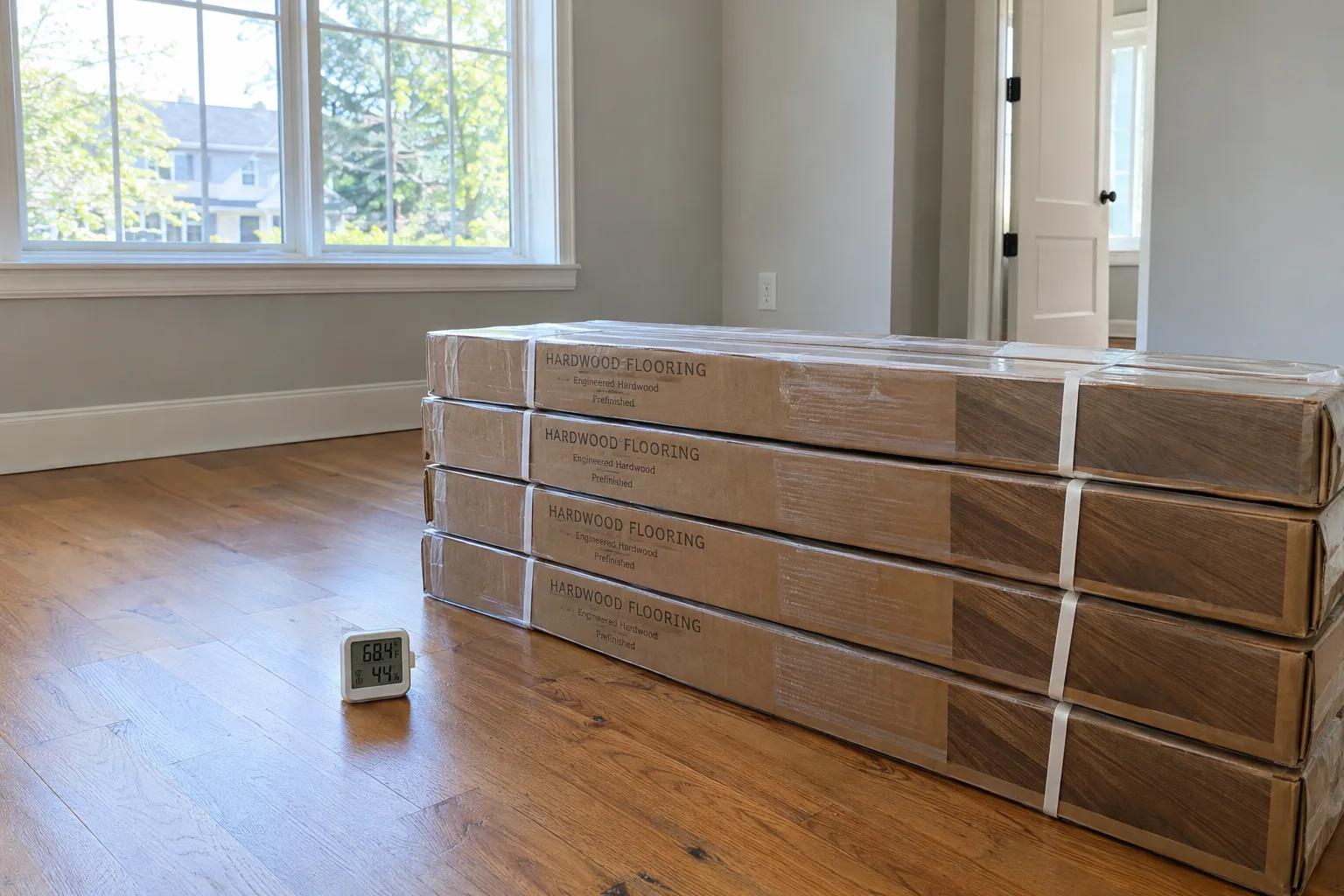
Key takeaways
- Follow the installation guide for your exact flooring product, not a general waiting period.
- Prepare the rooms and establish suitable indoor conditions before delivery.
- Room humidity, flooring moisture, and subfloor moisture are separate checks.
- Concrete needs material-appropriate moisture testing, not a wood-subfloor comparison.
- Tell Mike about basement dampness or recent wet work before arranging delivery.
- Confirm delivery, testing responsibilities, and readiness requirements before setting the installation date.
Your hardwood is ready when it meets the selected product’s installation instructions, your indoor conditions are suitable, and moisture testing supports installation. A delivery date alone cannot tell you that.
The NWFA installation guidelines call for checking and recording indoor conditions and subfloor moisture before delivery, then rechecking conditions when flooring arrives.
For your home near Taneytown, start with the exact flooring product and the condition of your rooms. Do not build the whole schedule around a generic three-day wait.
Why a fixed number of days is not enough
Wood exchanges moisture with the surrounding air. Its condition when delivered may differ from the conditions inside your home. The flooring, the subfloor, and the room environment all matter.
Flooring can sit for several days without becoming suitable for installation. That can happen if the house is too damp, heating or cooling is off, or moisture is entering from below. Waiting longer does not remove a leak or correct unsuitable storage conditions.
For your hardwood floor installation, discuss the product requirements and jobsite conditions with Mike before arranging delivery. Ask how readiness will be confirmed rather than assuming delivery starts a fixed countdown.
Find the instructions for your exact flooring
Find the installation guide for the product you plan to use. A brand name alone is not enough. Different collections from the same manufacturer can have different requirements.
For example, the CALI Meritage engineered flooring guide specifies 48 to 72 hours of acclimation along with moisture criteria. That is a product-specific example, not a rule for every engineered hardwood floor.
Both the timing and moisture requirements matter. If they cannot both be met, get direction from the manufacturer before proceeding. Do not treat either requirement as permission to ignore the other.
Before purchasing or scheduling delivery, send Mike:
- The manufacturer, collection, and exact product name.
- The model number or SKU and a product-page link.
- The current installation guide, preferably as a PDF.
- Whether the floor is solid or engineered hardwood.
- The rooms involved and what you know about the subfloor.
You can choose hardwood at Baltimore Floor Works, 142 Railroad Ave., Westminster, or at Lowe's or Home Depot. You can buy it yourself, or Mike can order the floor you selected, usually through Baltimore Floor Works. Mike does not bring samples to your house.
Prepare your rooms before delivery
Get the house close to the conditions you will maintain while living there. Follow the product guide for temperature, relative humidity, and how long those conditions must be maintained.
Do not rely on a brief burst of heating or cooling just before delivery. You need a suitable, stable indoor environment, not a temporary reading that changes overnight.
Complete moisture-producing work first. Bruce's acclimation guidance identifies painting, drywall work, and concrete work as conditions to address before acclimation. Finishing those tasks does not automatically mean the room is ready. The resulting moisture still needs to be considered.
Ask where the flooring should be stored and how the packages should be handled. Do not automatically open every carton, remove wrapping, or stack boards with spacers. Follow the selected product's instructions. A garage or basement is not automatically a suitable storage location.
Before delivery, confirm that:
- Heating or cooling is operating as required.
- Recent wet work is complete and indoor conditions are suitable.
- Leaks or known dampness have been investigated.
- The intended storage area is ready.
- The delivery route and placement plan are agreed upon.
Understand the checks behind a start date
Room conditions and material moisture are related, but they are not the same measurement. A room that feels comfortable can still have a moisture problem beneath the flooring.
| Check | What it helps establish |
|---|---|
| Room temperature and relative humidity | Whether the indoor environment meets the product requirements |
| Flooring moisture readings | Whether representative boards meet the applicable moisture criteria |
| Wood subfloor moisture readings | Whether the wood beneath the new floor is suitable |
| Concrete moisture testing | Whether the slab meets the requirements for the flooring and installation system |
Testing must suit the material. Concrete needs its own moisture testing. It is not assessed by applying a wood-subfloor comparison to a slab.
The NWFA guidelines support representative testing rather than relying on one reading from one board. Ask which readings are needed, where they will be taken, and which product limits apply.
Useful records identify the date, room or test location, material, readings, and applicable limits. An unusual result needs investigation rather than being overlooked because most readings look acceptable.
Confirm Mike's testing and delivery sequence for your job. Ask when indoor conditions, flooring moisture, and subfloor moisture will be checked, who is responsible, and what will be recorded. Do not assume a particular test or visit is included without discussing it.
What if your Taneytown home has a damp basement?
Suppose your older home has a damp basement beneath the room getting new hardwood. Tell Mike before arranging delivery. Describe musty odors, visible dampness, recent leaks, or water after rain.
Extra storage days upstairs will not fix an ongoing moisture source below the room. The source needs attention before deciding whether installation can proceed.
Opening basement windows is not always a drying strategy. Warm, humid summer air can reach cool basement surfaces and condense. The University of Minnesota Extension's basement moisture guidance explains this problem and the importance of identifying moisture sources.
This does not mean every Taneytown basement has a problem. It means known dampness should be part of the planning conversation, not a surprise on installation day.
Tell Mike if only part of the installation area sits above a basement or crawl space. Different areas may need separate attention rather than one assumption for the whole house.
Prepare access for the site visit
Ask Mike which areas he needs to reach before the visit. Plan for access to each installation room and any relevant basement or crawl-space entrance.
Keep entrances and walking routes clear. Move stored items away from access doors and areas that may need inspection. Report low clearance, locked doors, standing water, or other access concerns in advance. Do not enter an unsafe crawl space to prepare it.
Also identify rooms with a different subfloor or recent water damage. A dry-looking surface does not explain what is happening beneath it.
Your checklist before confirming installation
Treat delivery and installation as related decisions, not automatic back-to-back appointments. Before confirming the start date, check that:
- Mike has the exact product information and installation guide.
- Storage and carton-handling instructions are clear.
- Required room and below-floor access is available.
- Known moisture concerns have been addressed.
- Required timing and testing criteria have been checked.
- You know who will confirm readiness and when.
Ask what happens if the flooring arrives but conditions are not ready. Also ask whether any checks need repeating after delivery or a change in indoor conditions. Agreeing on that process beforehand can help you avoid planning around an unsupported start date.
Current rates are on the pricing page. The estimate tool shows a preliminary range, not a contract.
To plan your hardwood floor installation, call or text Mike at (410) 259-7094. Leave a voicemail if nobody answers. Mike has installed floors for 31 years, since 1995, and serves homes within about 50 miles of the Taneytown office.
Questions people ask
Is three days enough for hardwood to acclimate?
Not necessarily. Follow the installation instructions for your exact product. Any stated waiting period must be considered alongside suitable indoor conditions and the required moisture criteria.
Does engineered hardwood need acclimation?
Follow the exact product's installation guide. For example, CALI's Meritage guide specifies 48 to 72 hours along with moisture criteria. That requirement does not apply to every engineered hardwood product.
Can hardwood acclimate in a garage or basement?
Do not assume either location is suitable. Storage conditions and package handling must follow the selected product's instructions. Discuss the storage location with Mike before arranging delivery.
Will extra acclimation time solve a damp basement problem?
No. Extra storage days do not correct an ongoing moisture source. Tell Mike about basement dampness before delivery and address the source before deciding whether installation can proceed.
When does Mike check flooring and subfloor moisture?
Confirm the timing and responsibilities with Mike before arranging delivery. Ask which checks are planned before delivery, which may be repeated afterward, and what readings will be recorded. His exact sequence needs to be confirmed for your job.
Sources
- NWFA Wood Flooring Installation Guidelines, revised 2025, hosted in the February 2026 directory
- Olde Wood: Hardwood Floor Acclimation: How Long to Wait Before Installation?
- Bruce: Acclimating Wood Floors: Skipping This Step Can Cost You Later
- CALI Meritage Engineered Hardwood Flooring Installation Guide, hosted by Lowe’s
- University of Minnesota Extension: Moisture in basements: causes and solutions